
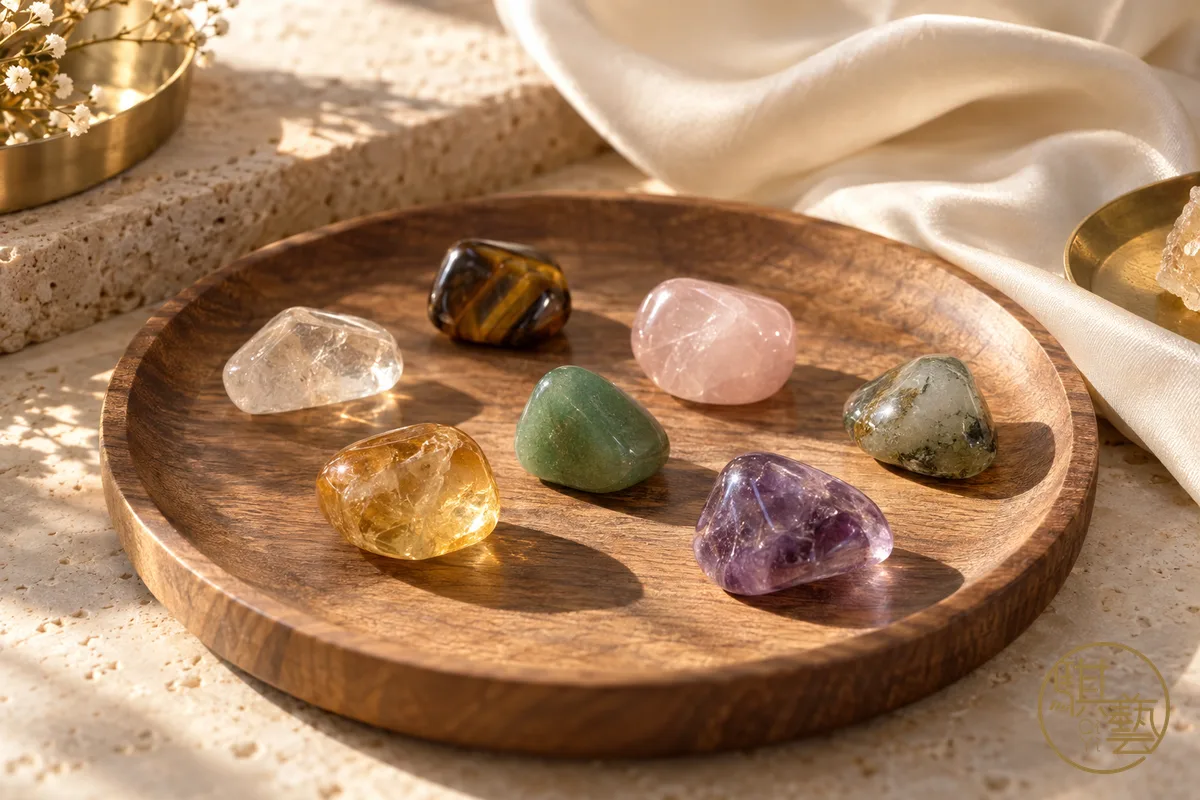
All three in one line: read your personality first, then pick the stone
Gold rutilated quartz has strong visual drama and, in folklore, symbolises drive and ambition; citrine has a warm glow and is beginner-friendly; green phantom quartz is richly layered and is said to symbolise steady accumulation. None is better or worse than the others. The key to choosing is your own taste, budget and the attitude to life you want to remind yourself of.
Mineral basics: what are you actually holding?
Gold rutilated quartz (Rutilated Quartz)
The mineralogical name for gold rutilated quartz is "rutile-included quartz". The golden hair-like strands inside are formed by titanium dioxide (rutile) minerals growing naturally within the quartz crystal.
- Mohs hardness: 7 for the quartz host, about 6 to 6.5 for the rutile inclusions themselves
- Main sources: Minas Gerais in Brazil, and Madagascar
- Appearance: transparent to semi-translucent base, containing gold, silver or red hair-like strands depending on the density of inclusions
- A note on market pricing: for natural, high-quality bracelets with evenly distributed strands, prices in the Taiwan market vary enormously, so be aware of the quality gap between "full-gold" pieces and those with sparse strands
Citrine (Citrine)
Citrine is the yellow to orange-yellow variety of the quartz family, its colour coming from trace ferric iron (Fe3+) in the crystal lattice.
- Mohs hardness: 7
- Main sources: Brazil, Bolivia, Spain, Madagascar
- Appearance: pale yellow to deep amber-yellow. Natural citrine tends to be lighter in colour and unevenly distributed; a great deal of "heat-treated amethyst" is also labelled as citrine on the market, so ask the seller about the source when buying
- Beginner-friendliness: relatively high, with a wide price range for both single loose stones and finished bracelets
Green phantom quartz (Phantom Quartz / Green Phantom)
The "phantom" structure of green phantom quartz is a layered outline formed when quartz paused repeatedly during growth, accumulated mineral impurities, and then continued to grow. The shapes sometimes resemble mountains or pyramids.
- Mohs hardness: 7
- Main sources: Brazil, Yunnan in China, Madagascar
- Source of the green: usually deposits of minerals such as chlorite or actinolite
- Appearance: one or more layers of green phantom outlines inside transparent quartz. The clearer the layering, the higher its market acceptance
Cultural symbolism side by side
| Gold rutilated quartz | Citrine | Green phantom quartz | |
|---|---|---|---|
| Cultural symbolism | Drive, breakthrough, active enterprise | Sunny positivity, optimism, a warm mindset | Steady accumulation, gradual progress, settled wisdom |
| Common contexts | A self-motivating piece when pursuing a goal | Everyday wear, a relaxed workplace mood | A companion stone for quiet reflection, the study, long-term planning |
| Western mineral lore | Said to symbolise solar energy and willpower | Associated with the solar plexus chakra, a symbol of confidence | Said to symbolise the memory of growth and nature's passage of time |
⚠️ All of the above are cultural symbolism and interpretation. They do not represent any medical effect, guarantee of wealth or prediction of the future.
Wearing and styling tips
Gold rutilated quartz: the star piece that lets the visuals speak
The golden strands shimmer under light, making it a natural focal point for a bracelet or necklace. It is best to wear it on its own or pair it with colourless clear quartz, so it does not compete with heavily coloured stones. If you prefer an understated look, choose a piece with sparser strands; if you love drama, go for a "full-gold" or "red rabbit hair" type.
Citrine: the gentle, versatile everyday choice
Its pale yellow tone works with most skin tones and pairs well with wooden beads, clear quartz or rose quartz. If you buy natural citrine, a lighter colour is normal; if a deep orange-yellow stone is priced surprisingly low, confirm whether it is heat-treated and factor that into your decision.
Green phantom quartz: the collector's piece worth savouring
The clearer the phantom outline and the more layers, the higher its acceptance among collectors. Because the green varies in depth, it is best to view its true colour in natural light and avoid light-box lighting that flatters it too much. It also works well as a desktop crystal point or a hand-worry stone, so its use is not limited to being worn.
Care notes
- Sunlight: all three are quartz. Prolonged intense sunlight may fade citrine (heat-treated pieces are especially sensitive); gold rutilated quartz and green phantom quartz are relatively stable, but it is still best to avoid long exposure
- Cleaning: rinse under running water and dry with a soft cloth. Avoid ultrasonic cleaners, which may crack the inclusions or phantom structures
- Storage: store separately or with a soft cloth between pieces to avoid scratching the surfaces
How do you decide which to buy? A simple self-questioning framework
- Visual preference: do you prefer golden shimmer (gold rutilated quartz), warm yellow translucency (citrine) or layered natural patterning (green phantom quartz)?
- Context of use: everyday wear, important occasions, or displayed quietly at home?
- Budget: high-quality gold rutilated quartz is usually the most expensive of the three per piece; citrine has the lowest entry point; green phantom quartz varies widely depending on how clear the phantom is.
- What belief do you want to send yourself: enterprising and driven, sunny and optimistic, or calm and accumulating?
Choosing a stone is essentially choosing a tangible symbol that reminds you of something each time you see it. The best crystal will always be the one that feels good to you when you look at it.