The Short Answer: Choosing Crystals by Your BaZi Useful God Is About Resonance With the Five Elements' Colours and Materials
If you have ever felt stuck on the question "which crystal suits me?", the BaZi Useful God offers a culturally grounded framework to reference. In simple terms: the Useful God represents the elemental energy your chart is said to need strengthened or balanced. Translated into crystal selection, that means using colour, mineral properties and visual texture to find the stone that speaks to you most.
What Is the BaZi Useful God? Understand This Before You Choose
BaZi, or the Four Pillars of Destiny, is made up of the Heavenly Stem and Earthly Branch for your year, month, day and hour of birth — eight characters in total. A practitioner assesses the strength of the Day Master and the balance of the Five Elements to identify the "favourable god" (the element considered beneficial to the chart) and the "useful god" (the most essential supporting element), together known as the Useful God (Xi Yong Shen).
A cultural note: The concept of the Useful God originates from the Qing-dynasty metaphysics text Zi Ping Zhen Quan and is one of the core methods for interpreting the Five Elements within the Four Pillars tradition. It belongs to East Asian philosophical heritage and is not a medical or scientific claim.
When choosing crystals, the Useful God offers a meaningful basis for selection — a personal story and direction to guide you through an overwhelming array of stones.
A Complete Guide to Crystal Materials by Element
🔩 Metal: Whites and Golds — Clarity and Lustre
The Metal element is represented by white, gold and silver, symbolising clarity, precision and a sense of order.
Common corresponding stones:
- Clear Quartz (Mohs hardness 7, sourced widely across Brazil and Madagascar): colourless and transparent, with a luminous clarity that best captures the "crisp Metal" visual feel.
- Moonstone (feldspar group, hardness 6–6.5): milky white with a blue sheen, soft and lustrous — ideal for those who like an understated Metal texture.
- Golden or Strawberry Rutilated Quartz: a pronounced metallic sheen that echoes a metal-like quality, usually on a Brazilian quartz base.
How it wears: Metal-family crystal bracelets look clean and are well suited to minimalist styles or everyday office wear.
🌿 Wood: Greens and Teals — Vitality and Depth
The Wood element corresponds to green and teal, symbolising growth, flexibility and an upward, forward energy.
Common corresponding stones:
- Green Phantom Quartz (hardness 7): containing green volcanic ash or chlorite inclusions, richly layered and full of life visually, sourced mainly from Brazil and China.
- Aventurine (hardness 6.5–7): an opaque jade green and a popular entry-level green stone, composed of chromium-bearing mica within quartzite.
- Jadeite / Burmese Jade (hardness 6.5–7): the classic Wood-element stone in Chinese culture, warm and fine in texture, with Burmese jadeite most prized in the market.
How it wears: Green bracelets bring a fresh, soothing feel — especially good for those who spend long hours at a screen and want to add a natural element to their look.
💧 Water: Blues and Blacks — Depth and Stillness
The Water element corresponds to blue, black and deep grey, symbolising flow, wisdom and reflection.
Common corresponding stones:
- Aquamarine (beryl group, hardness 7.5–8): a clear blue sourced mainly from Brazil and Madagascar, with a sea-like translucence.
- Kyanite (hardness 4.5–7, directional): a deep blue-grey, often in columnar crystals — a rare mineral with asymmetric hardness.
- Black Tourmaline (hardness 7–7.5): a deep, opaque black in the tourmaline group, a visually grounded and restrained Water-element choice.
- Smoky Quartz (hardness 7): a translucent brown-black, close in look to the black family, with a quietly composed feel.
How it wears: Water-family bracelets pair especially well with dark or cool-toned outfits, lending an overall look that feels distinctive and enduring.
🔥 Fire: Reds and Purples — Warmth and Presence
The Fire element corresponds to red, orange and purple, symbolising passion, expression and an outward, active posture.
Common corresponding stones:
- Garnet (hardness 6.5–7.5): a saturated deep red with a wine-like translucence in the light — one of the most representative stones in the Fire palette.
- Rhodochrosite (hardness 3.5–4.5): pink to rose red, often banded, with Argentina its best-known source.
- Amethyst (hardness 7): the most widely available stone in the purple family, its colour coming from iron ions and natural irradiation. Brazil, Uruguay and Zambia are all major sources, and the depth of colour varies considerably.
How it wears: Red-and-purple bracelets have a strong presence, ideal for social occasions or days when you want a visual focal point in your outfit.
🪨 Earth: Yellows and Browns — Stability and Warmth
The Earth element corresponds to yellow, beige, brown and coffee tones, symbolising stability, acceptance and grounded steadiness.
Common corresponding stones:
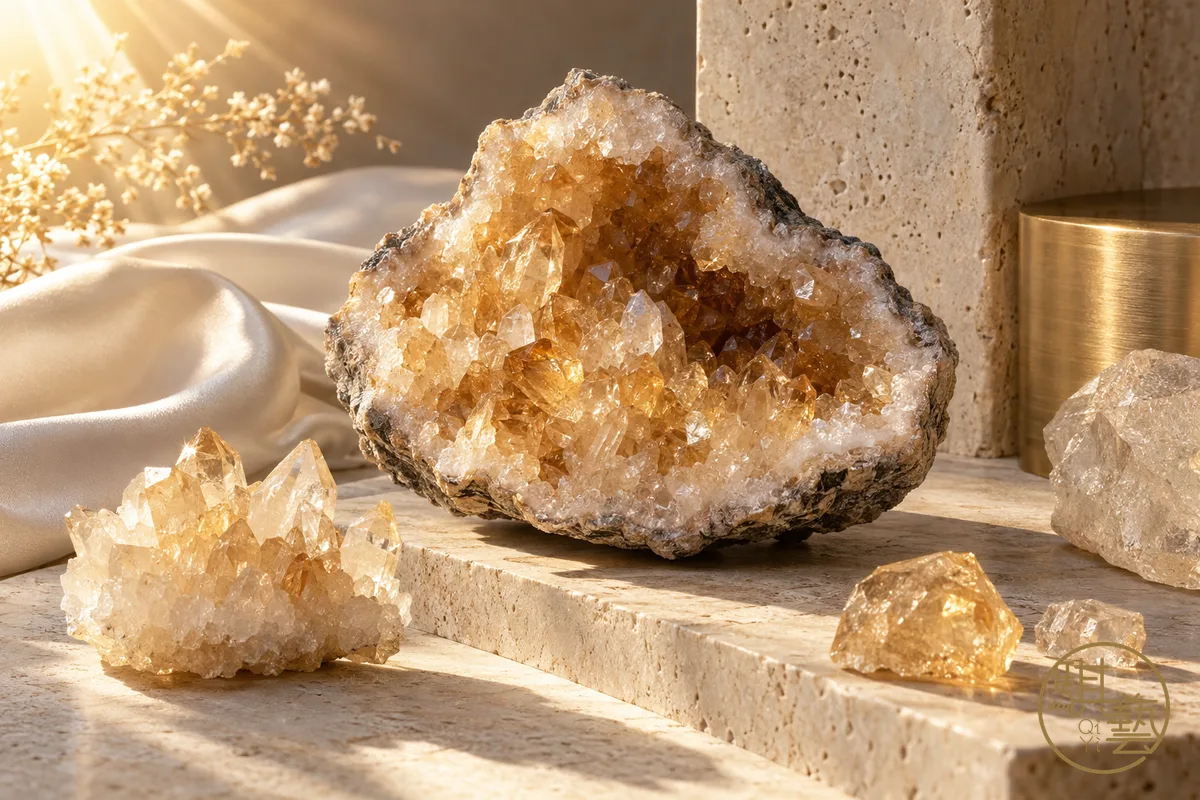
- Citrine (hardness 7): a golden, transparent yellow whose colour comes from the oxidation state of iron. Natural citrine is scarce, and much of what's on the market is heat-treated amethyst — it's worth confirming with the seller before you buy.
- Tiger's Eye (hardness 5.5–6): a golden-brown silky lustre, composed of quartz pseudomorphs after limonite, with South Africa the primary source.
- Sunstone (feldspar group, hardness 6–6.5): an orange-brown with metallic glints and a warm look, sourced from places including Norway and Oregon in the United States.
How it wears: Earth-family bracelets are versatile and easy to love, pairing almost seamlessly with earth-toned outfits — a low-maintenance choice for the daily commute.
Three Steps to Choosing in Practice
- Confirm your Useful God first: through a BaZi chart calculation (for example our free AI BaZi calculation), work out which favourable element (or elements — there may be more than one) your chart calls for.
- Match colour and stone: use the guide above to find the stones that resonate with you visually, and try wearing them.
- Blend aesthetics with your life: a crystal bracelet is, in the end, an accessory. The best choice is a stone you pick up each day and think, "yes, this is my style."
If you'd like to explore your BaZi and Useful God further, you're welcome to try our free AI BaZi calculation. It is calculated by AI, not read by a human practitioner, and it lays out your chart, elemental balance and a suggested favourable element in one go.
In Summary
The BaZi Useful God offers a culturally informed framework for choosing stones — not a guarantee or a prediction. Everyone's aesthetic preferences and daily habits differ, and in the end the bracelet that feels comfortable to wear and looks right to you is the crystal bracelet that truly suits you.