
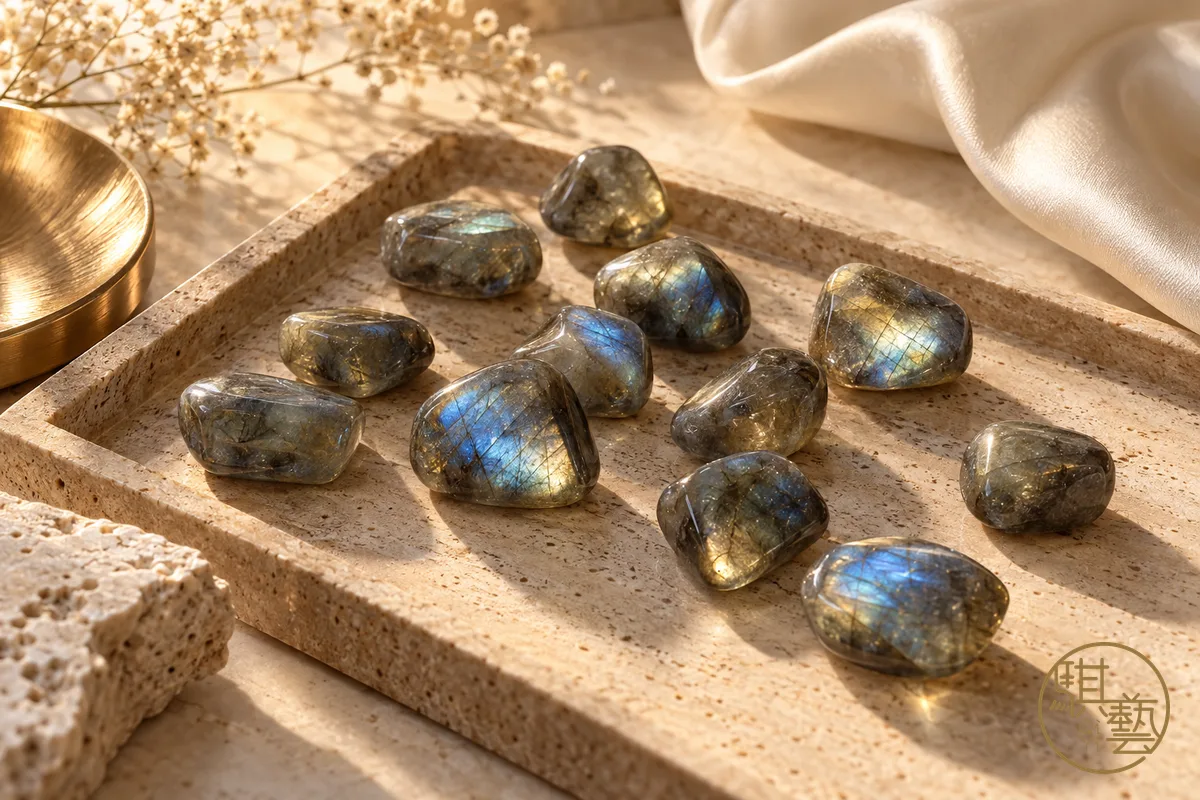
The best reason to own a labradorite bracelet, up front
The most captivating thing about labradorite is the rainbow flash of colour that seems to flow as you tilt the stone, a phenomenon known in the trade as labradorescence. When you are choosing a good labradorite bracelet, it all comes down to that flash: the wider the field of colour, the richer the tone and the deeper the layering, the more a bead is worth treasuring. Below, we walk you through it step by step, from reading the colour flash to judging bead quality and pairing it with your outfit.
What exactly is labradorescence? Getting to know the flash
Labradorite is a member of the feldspar family, a calcium-sodium feldspar with a Mohs hardness of roughly 6 to 6.5. Its most famous source is the Labrador Peninsula in Canada (which is where the name comes from), with other important deposits in Finland, Madagascar and Mexico.
Inside labradorite there are fine, alternating layered structures (known as exsolution lamellae). When light enters and reflects and interferes between these layers, it produces flowing flashes of blue, green, gold, orange and even purple-red. This effect is what we call labradorescence, a close cousin of the adularescence seen in other feldspars.
A rough guide to labradorescence colour grades
| Flash colour | Relative rarity | Appearance |
|---|---|---|
| Blue / blue-violet | Most common, and most popular | Deep as a starry sky, with a strong sense of movement |
| Green / yellow-green | Moderate | Fresh and natural, richly layered |
| Gold / orange-gold | Less common | Warm sheen, high visual impact |
| Full-spectrum multicolour | Rare | Known as "spectrolite", several colours visible at once |
Four keys to choosing a labradorite bracelet
1. How wide is the flash? The larger the coverage, the better
On the same bead, some flashes light up only a small corner while others glow across almost the entire surface. When shopping, hold the bracelet under natural light or a white daylight lamp and slowly rotate it, watching how much of each bead lights up. On a good labradorite bracelet, the flash on each bead should cover more than 50% of the surface, and the colour should be reasonably even across the strand, rather than a few beads glowing brightly while the rest stay dull as ordinary stone.
2. How saturated is the flash? Pure in tone, never grey or cloudy
Blue is labradorite's most sought-after flash colour. A good blue should be a saturated, clear royal or icy blue, not a greyish or hazy, muddied blue. Once you have a bead in hand, view it from different angles:
- Head-on: is the colour saturated and does it have depth?
- From the side: does the flash have front-to-back depth, or is it just a thin surface layer?
Beads with deeper, more saturated flash usually have finer, denser internal layering and tend to be higher quality.
3. Body colour and translucency: shaping the overall look
Labradorite's body colour is usually grey-black, dark grey or a brownish grey. The darker the body, the stronger the contrast with the blue flash and the more striking the effect; lighter grey-white bodies give a softer, dreamier glow. Neither is objectively better; it comes down to your personal style.
As for translucency, labradorite ranges from semi-translucent to opaque. There is no need to chase high transparency, because the very layered structures that create the flash also block light. High transparency means fewer of those layers, which can actually weaken the flash.
4. Bead shape and polish: craftsmanship shapes the flash
The curvature of a round bead directly affects how the labradorescence shows. Too shallow a curve (a flattish bead) or a less-than-fine polish will make the flash look scattered and unfocused. When choosing, look for:
- Beads that are truly round (consistent in size)
- A smooth, well-polished surface with no obvious pits or cutting marks
- Common bead sizes: 6mm is light and easy for everyday wear; 8mm is the most popular mainstream size; 10mm and up make a strong visual statement and suit a feature piece
Everyday wear and care for your labradorite bracelet
Wearing tips
With a Mohs hardness of around 6 to 6.5, labradorite is a little softer than quartz-family crystals (hardness 7). When wearing it, avoid knocking it against hard objects or stacking and rubbing it against other bracelets, so the bead surface does not pick up fine scratches that dull the flash.
Cleaning and care
- Everyday cleaning: simply wipe gently with a slightly damp soft cloth. Avoid detergents, alcohol and ultrasonic cleaners.
- Avoid long soaks: labradorite has cleavage planes, and prolonged soaking may damage the structure or loosen the drill holes.
- Avoid strong direct light: prolonged exposure to intense sunlight may slightly alter the body colour, so store it somewhere cool and shaded.
- Check the stringing: every 1 to 2 years, have a professional brand check the elastic cord or silk thread and restring as needed based on wear.
The cultural lore and aesthetic style of labradorite
In Norse legend, labradorite is described as a stone that captured the northern lights, a symbol of mystery and transformation; the Inuit of Canada also have a legend about its origins, believing it to be fragments of the aurora that fell into the rocks. These stories lend labradorite a uniquely mysterious aesthetic and have earned it a firm place in both mineral collecting and fashion styling.
In terms of styling, the deep grey body of a labradorite bracelet has a universally versatile, neutral quality, while the blue flash adds a mysterious highlight to any look. Whether your style is minimalist, bohemian or everyday quiet luxury, a labradorite bracelet with a rich, full flash makes an understated yet eye-catching focal point.
The quick buyer's cheat sheet
✅ Wide flash (large coverage area) ✅ Saturated blue tone, not grey or cloudy ✅ Dark grey body for strong contrast, or light grey for a softer feel (your preference) ✅ Truly round beads with a fine polish ✅ Choose 8mm for the most versatile everyday size ❌ Avoid low-quality beads where the flash sits in one small corner while the rest stays dull