Why Do People Buy Moonstone Bracelets Again and Again?
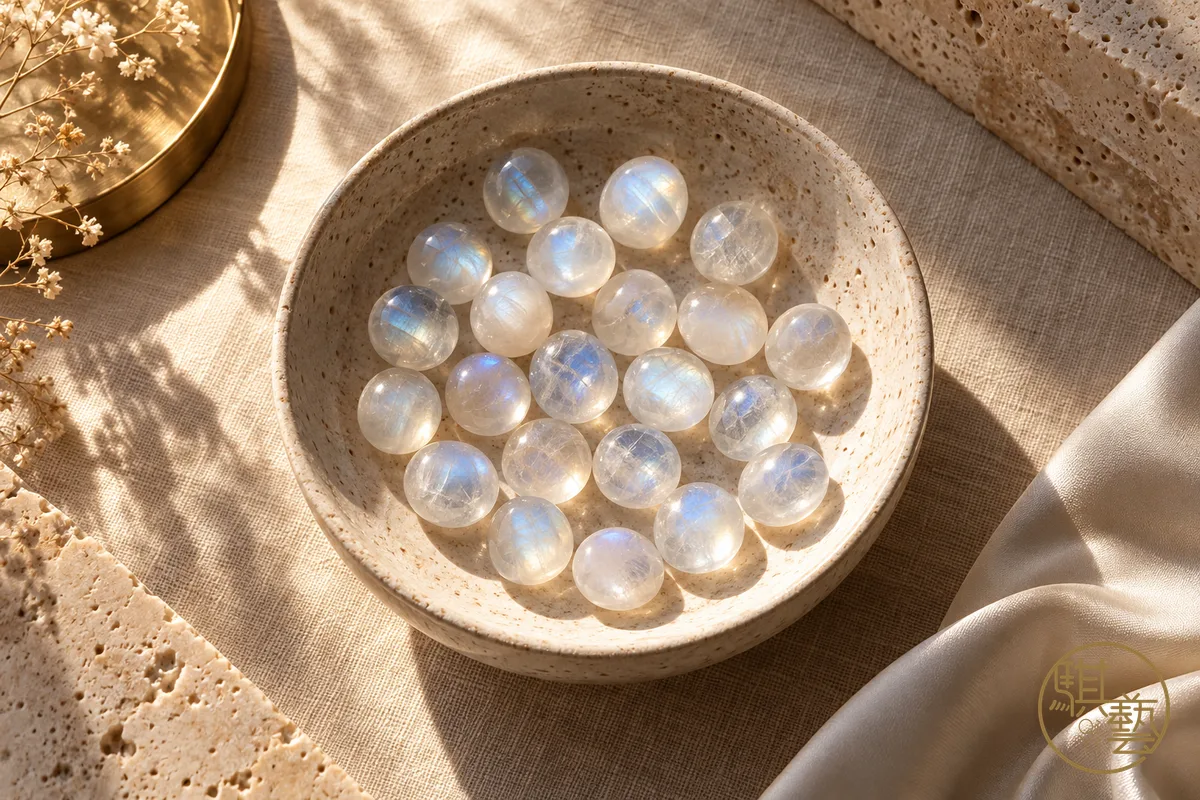
Moonstone bracelets have long sat near the top of the repeat-purchase list among natural crystals, and the reason is simple: their look is gentle without being dull. In the light, the semi-transparent milky-white beads flow with a bluish-grey sheen (what enthusiasts call the 'blue flash' or 'schiller'), like moonlight scattered across water — the longer you look, the more your mind seems to quiet along with it.
Culturally, moonstone has a long history of being worn in India, Europe and East Asia, symbolising gentleness, intuition and inner calm — precisely the qualities many people most want their everyday jewellery to convey.
What Is Moonstone? Let's Build the Basics First
Mineral Identity and Hardness
Moonstone belongs to the feldspar group. Chemically, it is an interleaved layered structure of orthoclase and albite feldspar, and it's precisely these alternating thin layers that scatter light to create its distinctive 'moonstone effect' (the technical term is adularescence, an iridescent sheen). Its Mohs hardness is about 6 to 6.5, making it medium in hardness — slightly softer than quartz-family crystals (hardness 7) — so it takes a little more patience to care for.
Main Sources
The moonstone commonly seen on the market today comes from:
- Sri Lanka: the clearest, most luminous blue sheen and high transparency, regarded as the top-tier source.
- India: often an orange-brown base with a blue sheen (commonly called 'rainbow moonstone'), rich in layered colour.
- Myanmar and Madagascar: variable in quality, requiring careful identification.
Moonstone vs. Howlite vs. Glass Imitations
The most common confusion before buying:
| Feature | Natural moonstone | Howlite (white chalcedony etc.) | Glass imitation |
|---|---|---|---|
| Sheen | Three-dimensional, flowing | No obvious sheen | Fixed sheen that doesn't flow |
| Temperature | Cool to the touch | Cool | Warms up quickly |
| Price | Higher | Low | Very low |
| Inclusions | Faint cloudy wisps visible | Uniform, no special structure | Air bubbles |
Key Points for Choosing a Moonstone Bracelet: 4 Details You Can't Skip
1. Blue Sheen Quality: The More It 'Flows', the More Precious
When choosing a moonstone bracelet, hold the beads under a light and rotate them slowly, watching whether the blue sheen 'moves along'. True adularescence has depth — as the light moves, the position of the sheen drifts with it; if the sheen is a static white reflection, it's usually lower quality or a glass imitation.
Prioritise the following:
- Blue sheen covering 50% or more of the bead's surface
- A cool blue or blue-grey sheen, rather than pure white
- A natural variation in sheen strength across the strand (not every bead identical)
2. Transparency and Impurities
Top-grade moonstone has high transparency with only natural cloudiness inside; if a bead is murky, heavily spotted with black, or obviously cracked, both durability and visual effect suffer. When buying, shine a torch from the side to check how clean the interior is.
3. Bead Shape and Polish
Round beads are the most common choice, but oval cabochons display the moonstone effect more fully and suit stones with a strong blue sheen. The polished surface should be smooth and even — run a fingertip over it to feel for dips or the roughness of uneven cutting.
4. Cord and Metal Fittings
Moonstone bracelets on the market are usually strung with elastic cord or waxed cord. Elastic cord is easy to put on but tends to slacken over long use; better-quality pieces use double- or triple-stranded nylon waxed cord tied off with a knot, balancing strength and looks. For metal fittings, choose 925 sterling silver or rhodium-plated pieces, which resist oxidation and discolouration and best complement moonstone's cool tones.
Everyday Styling Suggestions for Moonstone Bracelets
Moonstone's cool white palette is extremely forgiving and blends with almost any outfit. Here are a few practical directions:
- Minimalist, worn alone: a 6mm small-bead piece with a plain outfit — elegant and never overpowering.
- Stacked layering: pair with a clear quartz bracelet or a transparent topaz bracelet for a light, tidy white-tone stack.
- Matching pair for couples/friends: moonstone with black rutilated quartz or black spinel for a crisp black-and-white contrast — a meaningful, memorable gift.
- Mixed with metal: a 925 sterling silver bangle + a moonstone bracelet; the cool metallic feel makes the moonstone look even more refined.
💡 If it's your first moonstone bracelet, start with an 8mm round-bead piece — the larger sheen display gives the most immediate visual effect.
Moonstone Bracelet Care Guide: Softer Stone, More Careful Handling
With a hardness of 6-6.5, moonstone scratches more easily than quartz-family crystals, so keep these everyday principles in mind:
Everyday Use Notes
- Last on, first off: take it off before exercise, washing up or bathing to avoid impact and contact with chemicals.
- Keep perfume and lotion away: chemical ingredients erode the polished surface and gradually blur the moonstone effect.
- Store separately: moonstone is softer than quartz, so keeping it with citrine, amethyst and the like risks scratches — store it in its own velvet pouch or jewellery compartment.
Cleaning Method
- Simply wipe the beads gently with a lightly dampened soft cloth.
- For a more thorough clean, soak in room-temperature water for 5 minutes, then gently brush the crevices with a soft toothbrush and let it air-dry completely before storing.
- Never use an ultrasonic cleaner: the shockwaves easily damage moonstone's internal layered structure — at best it loses its blue sheen, at worst it shatters.
- Avoid prolonged direct sunlight: UV light may gradually dull the moonstone's surface lustre.
Recommended Care Cycle
For everyday wearers, we suggest checking the cord's elasticity every 1-2 months; at the first sign of slackening, take it to a professional shop to be re-strung, to avoid the cord snapping and losing beads.
Who Is a Moonstone Bracelet For?
From the angle of cultural and emotional companionship, the character of a moonstone bracelet suits:
- People who love cool tones and prefer understated, refined jewellery
- Those under daily work pressure who want a piece that lets the eye 'pause and take a breath'
- A gift for a friend or partner who values inner feeling and dislikes flashy design
Moonstone has no gender limitation, but its gentle, reserved visual language does pair more frequently with everyday women's styling — which is the core reason it has long been a repeat favourite among women.
To learn more about the crystal type that suits you, feel free to try our free AI BaZi calculation for AI-suggested stones, or browse the bracelet collection to find the one that's yours.