
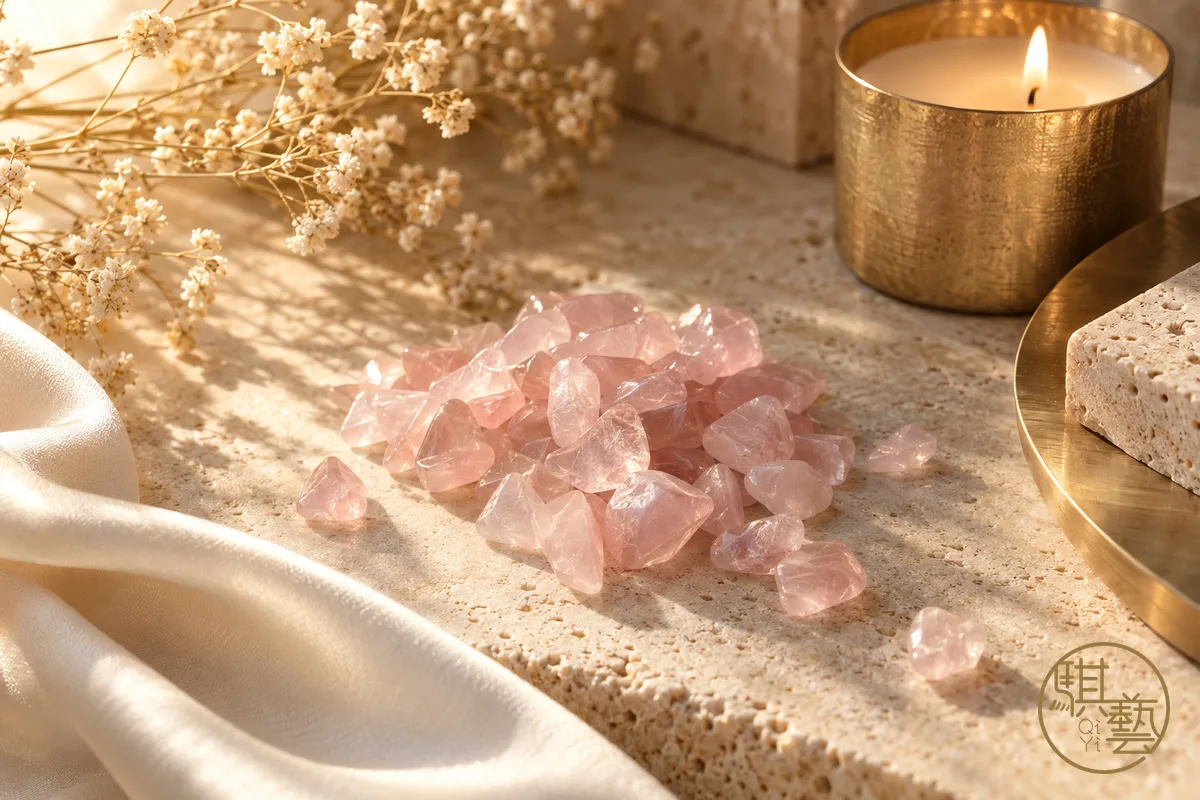
What Is a Rose Quartz Bracelet, and Why Is It the Go-To First Crystal?
Rose quartz is the rosy variety within the silica (quartz) mineral family, with a Mohs hardness of 7. Its main sources include the Minas Gerais region of Brazil, Madagascar, and South Africa. The soft pink tones come from trace amounts of titanium, iron, or manganese within the crystal, creating a rich range of shades from pale blush to deep rose.
In crystal culture, rose quartz has long been associated with the imagery of "gentleness, warmth, and harmony in relationships." Add its approachable price and easy-to-match color, and it naturally becomes the first stepping stone into the world of natural crystals for many people.
How to Choose a Rose Quartz Bracelet Worth Keeping
1. Color: Evenness Matters More Than Depth
The color of natural rose quartz usually isn't overly saturated. If you see a color as deep as candy, or an entire strand that looks perfectly identical, it may be dyed or synthetic. When choosing, give priority to strands with a soft color and slight variation between beads, which is the normal look of natural mineral material.
2. Clarity: A Cloudy Look Is Normal
Most rose quartz carries a "cloudy," semi-translucent quality, caused by fine fibrous inclusions within the crystal (a scattering known as the Tyndall effect) rather than being a flaw. If a bead is perfectly clear like glass, it's worth double-checking whether it's synthetic quartz.
3. Bead Size: Choose by Wrist Thickness
| Wrist circumference | Suggested bead size |
|---|---|
| 14-15 cm | 6 mm |
| 15-17 cm | 8 mm |
| Over 17 cm | 10 mm |
The larger the bead, the greater the sense of visual weight. If you want to stack several strands, we suggest starting with 6 mm as a base and pairing it with different materials or color tones.
4. Elastic Cord or Hand-Knotted String?
Most bracelets on the market use elastic silicone cord, which is easy to slip on and off but tends to age and snap over long-term use. When buying, you can ask about the cord material the brand uses; high-quality pieces typically use high-tensile elastic cord of 0.8 mm or thicker, or offer a re-stringing service.
Should You Wear a Rose Quartz Bracelet on Your Left or Right Hand?
This is one of the most searched questions. The popular saying that energy "enters on the left and exits on the right" comes from a traditional Chinese notion of energy flow, and isn't based on mineralogy or science.
From the standpoint of actual wearing comfort:
- If you're right-handed, wearing it on your left hand means it's less likely to rub or knock against things during daily activities, which extends the bracelet's life.
- If you use both hands a lot (such as designers or musicians), choose your non-dominant hand to reduce the chance of bumps.
- For stacked styling: rose quartz pairs beautifully with clear quartz, moonstone, pearl, and other pale tones. You can stack different bead sizes on the same wrist to create a layered look.
Bottom line: which hand you choose depends on your habits and styling needs. There's no hard rule.
Everyday Care and Cleansing for a Rose Quartz Bracelet
Everyday Wearing Notes
- Avoid contact with chemicals: perfume, alcohol, and bleach can all dull the surface of rose quartz or speed up the aging of the elastic cord, so it's best to put your bracelet on after applying makeup and skincare.
- Avoid impact and high heat: although a Mohs hardness of 7 is fairly wear-resistant, a hard knock can still cause cracks. It's also best to take it off in high-heat environments like hot springs and saunas.
- Remove it before swimming: both chlorine and salt water are unkind to elastic cord.
Cleaning Methods
- Everyday wiping: gently wipe the bead surfaces with a soft cloth or lens cloth to remove fingerprints and skin oils.
- Periodic rinsing: every 2 to 4 weeks, rinse for about 30 seconds under room-temperature water, then blot dry with a soft cloth and let it air-dry in a well-ventilated spot. Avoid ultrasonic cleaners, as the vibration can widen natural fissures.
The Cultural Practice of Cleansing and "Recharging"
Many crystal enthusiasts like to "cleanse" their bracelets regularly. This is a ritual practice rooted in New Age culture, with common methods including:
- Moon bath: around the full moon, place the bracelet on a windowsill to receive moonlight overnight (avoid direct rain).
- Singing bowl sound waves: circle a singing bowl around the strand for a few minutes, for the sense of ritual relaxation it brings.
- Resting on a clear quartz cluster: set the bracelet on a clear quartz cluster overnight.
The practices above belong to the personal, spiritual, or psychological realm and have no scientific proof, but if they give you a sense of mental reset, that too is part of the aesthetics of everyday life.
Who Is Rose Quartz Suited To?
Rose quartz has an easy-to-match color and a gentle character, making it suitable for almost every skin tone. Both cool, fair skin and warm, golden skin can find a pink shade to match. If you'd like an accessory that carries a "soft, approachable" style impression, rose quartz is an excellent value.
For beginners just getting into natural crystals who aren't yet sure which stones they like, we suggest starting with rose quartz or clear quartz: both are versatile pieces and make a great base for stacking and combining later on.
Quick Summary
- Choosing: a soft, even color with a natural cloudy quality, and a bead size chosen to fit your wrist.
- Wearing: either hand works, as long as it doesn't get in the way of daily activities; pairs well stacked with pale tones.
- Care: keep it away from chemicals and high heat, rinse periodically with plain water, and air-dry with a soft cloth.
- Cleansing: moon baths, singing bowls, and the like are personal ritual choices, not requirements.